

66 million years ago, something the size of a small city slammed into what is now Mexico’s Yucatan Peninsula at 45,000 miles per hour. The impact vaporized rock, ignited continents, and ended the age of dinosaurs in a geological eyeblink. But here’s the twist: not all dinosaurs died. The ones that survived? You see them every morning at your bird feeder.
The short answer
An asteroid roughly 10 kilometers (6 miles) wide struck Earth 66.043 million years ago, creating the Chicxulub crater and triggering the Cretaceous-Paleogene extinction event. The impact—combined with massive volcanic eruptions already underway in India—eliminated approximately 75% of all species on Earth, including all non-avian dinosaurs.
The Chicxulub impact: what actually hit us
The asteroid that ended the Cretaceous period wasn’t just big—it was catastrophically energetic. When it punched into the shallow seas off the Yucatan, it released staggering amounts of energy, carving out a crater 180 kilometers (112 miles) wide and sending shockwaves through the planet’s crust.
We know this happened because the physical evidence is undeniable. The Chicxulub crater was confirmed in 1991 through gravity mapping, drill cores, and the telltale signature of shocked quartz—a mineral structure that only forms under the extreme pressures of asteroid impacts or nuclear blasts. A thin layer of iridium (an element rare on Earth but common in asteroids) appears in 66-million-year-old rock layers worldwide, marking the exact moment the sky fell.
This wasn’t a gradual decline. According to a comprehensive 2010 review in Science by Schulte and colleagues, the main extinction pulse happened within days to months of impact—geologically instantaneous.
How the impact actually killed
Here’s where most explanations stop short. Yes, it got dark and cold—but how did that cascade through the food web?
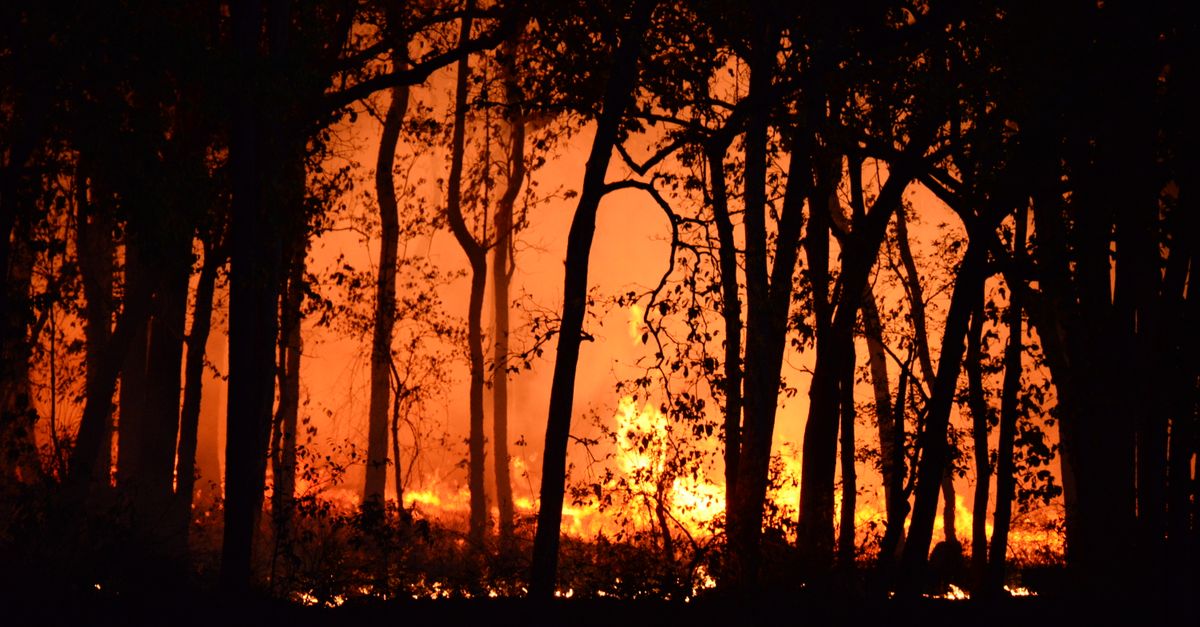
The impact vaporized sulfate-rich limestone at the impact site, releasing enormous amounts of sulfur dioxide and carbon dioxide into the atmosphere. Within hours, thermal radiation from ejected debris ignited wildfires across North America and beyond. The real killer, though, was what came next: dust and sulfate aerosols formed a global shroud that blocked sunlight for months, possibly years.
Photosynthesis collapsed. Plants died. Herbivores starved. Carnivores that depended on those herbivores followed. The food web didn’t fray—it snapped. Global temperatures plummeted 20–30°C within weeks, a climate whiplash that left survivors in ecosystems nothing like the ones they’d evolved for.
The one-two punch: volcanoes were already erupting
Here’s what most accounts miss: Earth’s ecosystems were already under siege when the asteroid hit. The Deccan Traps—a massive volcanic region in what is now India—had been erupting for nearly 2 million years by the time of the Cretaceous-Paleogene event. These weren’t ordinary eruptions. They released vast quantities of lava and flooded the atmosphere with sulfur dioxide and carbon dioxide, driving climate swings and acid rain.
The volcanism alone might have caused a slow-motion extinction over millennia. The asteroid extinction wasn’t a single catastrophe—it was the final, acute blow to an ecosystem already weakened by volcanic stress. Think of it as a forest fire hitting a drought-stricken landscape. The fire is the visible killer, but the drought set the stage.
What “extinction” actually meant—and who survived

When we say “the dinosaurs went extinct,” we’re not telling the full story. Roughly 75% of all species disappeared, but extinction wasn’t random. Small-bodied animals, burrowers, scavengers, and anything that could eat seeds or detritus had better odds. Crocodilians survived. Mammals survived. Marine turtles survived.
And birds—descendants of small feathered theropod dinosaurs—survived.
This is not a metaphor. By every modern phylogenetic classification, birds are dinosaurs. When you watch a heron stalk a pond or a hawk ride a thermal, you’re watching a living dinosaur hunt. The Cretaceous-Paleogene extinction didn’t erase dinosaurs—it pruned them back to one resilient branch. That branch now includes over 10,000 species, from hummingbirds to ostriches.
So the answer to “did dinosaurs go extinct?” is technically no. The non-avian dinosaurs—the ones that couldn’t fly, couldn’t burrow, and depended on ecosystems that vanished overnight—did. But their descendants adapted, radiated, and still fill the skies.
What this tells us about rare catastrophes
The asteroid impact extinction is a reminder that Earth’s history isn’t just slow, Darwinian selection. It’s also punctuated by sudden, nearly random catastrophes that reset the evolutionary game board. Dinosaurs dominated terrestrial ecosystems for 165 million years—a staggering success by any measure. Their extinction wasn’t a failure of fitness. It was bad luck on a planetary scale.
The good news? We now track near-Earth asteroids and have early-stage deflection technology. The challenging news? Detecting an impactor before impact remains difficult, and scientists continue to debate the exact trajectory of the Chicxulub asteroid—a reminder that even Earth-changing events can arrive with limited warning.
The next time you see a sparrow, remember: you’re looking at the only dinosaur lineage to survive the worst day in Earth’s history. Not bad for a group supposedly “gone forever.”
Written for general interest and accuracy-checked, but not a substitute for specialist sources.
FAQ
When did dinosaurs go extinct?
66.043 million years ago, at the Cretaceous-Paleogene boundary. The precision comes from radiometric dating of impact debris layers found worldwide.
How big was the asteroid that killed the dinosaurs?
Approximately 10 kilometers (6 miles) in diameter—about the size of a small city or twice the height of Mount Everest.
Did anything survive the asteroid impact extinction?
Yes. Birds (avian dinosaurs), crocodilians, small mammals, many fish and amphibians, and some marine reptiles survived. Small body size, burrowing behavior, and reliance on seeds or dead organic matter improved survival odds.
Was it just the asteroid, or did volcanoes play a role?
Both. The Deccan Traps volcanic eruptions in India were ongoing at the time of impact and likely weakened ecosystems beforehand. The asteroid delivered the final, catastrophic blow to an already stressed planet.
Are birds really dinosaurs?
Yes. Birds evolved from small feathered theropods and are classified as avian dinosaurs by paleontologists. Saying “dinosaurs are extinct” is like saying “mammals are extinct” because saber-toothed cats died out—it ignores the thriving descendants.