
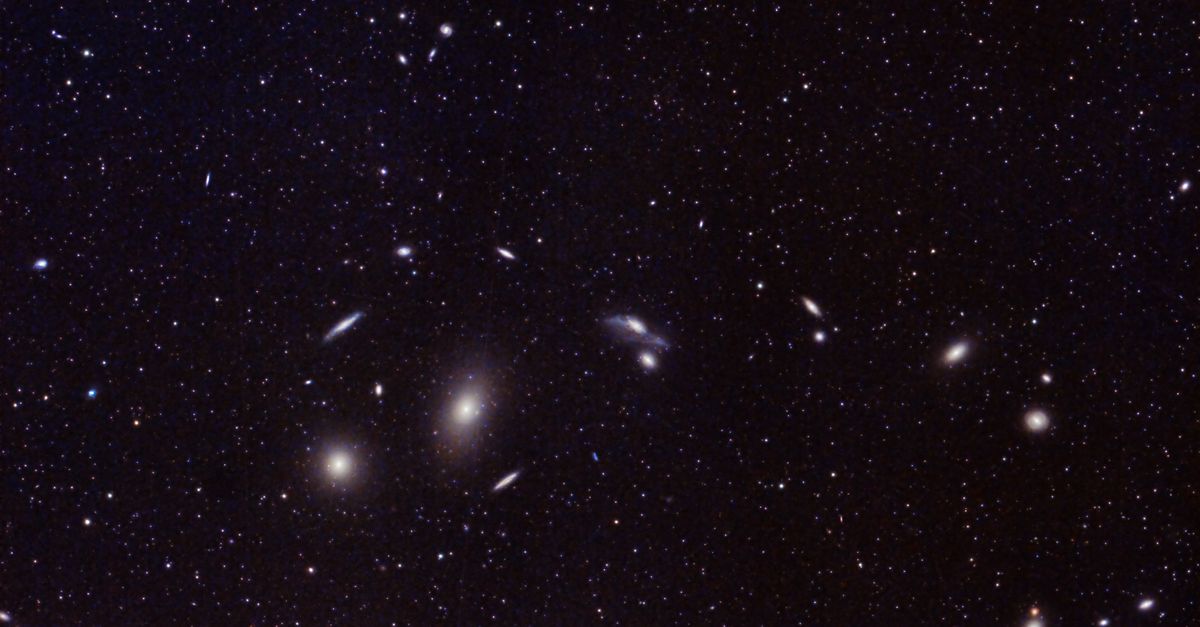
The biggest black hole we’ve found sits at the center of a galaxy a billion light-years away, and it weighs somewhere between 170 and 310 billion times the mass of our Sun. That’s Holm 15A—the current record-holder. But that 140-billion-solar-mass margin of error isn’t a typo. It’s a reminder that measuring something you can’t see, a billion light-years away, is genuinely hard.
The short answer
The largest black hole currently known is at the center of galaxy Holm 15A, with a mass estimated at 170 to 310 billion solar masses. Its event horizon—the boundary beyond which nothing escapes—has a radius around 1,650 times the distance from Earth to the Sun. TON 618, once thought to be the largest, ranks second at roughly 66 billion solar masses.
Why “biggest” keeps changing
Black holes don’t glow. We measure them by watching what does: stars whipping around an invisible center of mass, gas clouds spiraling inward and heating up, or light from distant quasars delayed by gravitational effects. Each method requires assumptions about geometry, orientation, and physics we can’t directly observe.
Stellar kinematics—tracking how stars orbit—works beautifully for nearby galaxies where we can resolve individual stars. But for distant galaxies like Holm 15A’s host, astronomers rely on gas kinematics: they measure Doppler shifts in ionized gas swirling near the black hole and work backward to infer the mass pulling on it. That requires guessing the gas’s geometry and how the disk is tilted relative to us. Get that wrong by 20 degrees, and your mass estimate shifts by 50%.
For the most distant black holes—those in quasars like TON 618—astronomers use reverberation mapping. They measure how long it takes for a flare of ultraviolet light from near the event horizon to light up hydrogen clouds farther out. The time lag reveals the cloud’s distance, which constrains mass. But it assumes the clouds orbit in a predictable pattern and that the accretion disk behaves consistently. Real disks are turbulent, clumpy, and messy.
The result: every black hole mass comes with error bars the size of entire galaxies’ worth of stars. Holm 15A’s measurement, published by van den Bosch and colleagues in 2015 using Hubble and ground-based spectroscopy, gave a range of 170 to 310 billion solar masses. That’s not uncertainty about decimals—it’s a factor-of-two spread in the most precise measurement we have.
The top contenders for largest black hole

Holm 15A sits in the center of a massive elliptical galaxy in the Abell 85 cluster. At 170–310 billion solar masses, it’s an ultramassive black hole—the informal term for the absolute largest supermassive black holes, those above 10 billion solar masses. Its event horizon radius is roughly 1,650 times the Earth-Sun distance, meaning if you placed it at the center of our solar system, the horizon would extend well past Neptune’s orbit. It’s not actively feeding right now, which makes it harder to study but also means the measurement isn’t confused by a bright quasar.
TON 618, a quasar 18.2 billion light-years away, held the “largest” title until better measurements of other candidates came in. Its mass is around 66 billion solar masses—still staggeringly large, but less than half Holm 15A’s. Because it’s an active quasar, TON 618 is easier to observe: its accretion disk glows brightly in optical and infrared. Reverberation mapping studies tracked light echoes to estimate its mass, but quasar measurements are inherently trickier because the disk’s structure changes over time.
The Phoenix Cluster black hole (formally PKS 1839-64) weighs in at roughly 20 billion solar masses—far smaller than the top two, but worth mentioning because of its outsize influence. This black hole is actively blowing bubbles of superheated gas into the surrounding galaxy cluster, regulating star formation across millions of light-years. It’s a textbook example of feedback: black holes shaping their cosmic neighborhoods despite being invisible.
What “size” actually means
When astronomers say “biggest,” they mean mass—how much stuff the black hole contains, measured in multiples of the Sun’s mass. But black holes also have a physical size: the event horizon, the spherical boundary where escape velocity hits the speed of light.
For a non-rotating black hole, the event horizon radius scales directly with mass. Holm 15A’s 170-billion-solar-mass lower estimate gives an event horizon radius of about 1,650 AU, where 1 AU is the Earth-Sun distance. TON 618’s 66-billion-solar-mass estimate gives roughly 195 AU. Mass and diameter rankings align—Holm 15A wins on both counts.
You couldn’t see the event horizon even if you were orbiting nearby; it’s a mathematical surface, not a physical wall. The closest we’ve come to imaging one is the Event Horizon Telescope’s image of M87’s black hole, which is only 6.5 billion solar masses and much closer to us. Holm 15A is too distant and its angular size too small for current instruments to resolve.
The measurement methods, decoded
Stellar dynamics: Track individual stars orbiting the black hole. Measure their velocities via Doppler shifts. Plug into Kepler’s laws. The tighter and faster the orbits, the more massive the center. This works for nearby galaxies like the Milky Way’s central black hole (Sagittarius A*, 4.1 million solar masses), where we can watch individual stars over years. For galaxies a billion light-years away, individual stars blur into a collective smudge.
Gas dynamics: Observe emission lines from ionized gas—often hydrogen or oxygen—near the black hole. The gas’s velocity tells you the gravitational pull. The catch: you’re assuming the gas moves in a predictable disk. Real gas has turbulence, winds, and outflows. Orientation matters, too. If the disk is edge-on, you see maximum Doppler shifts; face-on, you see almost none. Holm 15A’s measurement rests on modeling this geometry carefully.
Reverberation mapping: For quasars, monitor how long it takes for continuum light from the accretion disk to light up broad hydrogen emission lines farther out. The lag time tells you the distance between the two regions, and from that you calculate the black hole’s gravitational influence. This requires years of telescope time and assumes the emitting clouds orbit predictably. TON 618’s mass comes from this method.
None of these methods see the black hole. They all infer it from how matter behaves nearby. That’s why two teams analyzing the same data with slightly different assumptions can get answers that differ by 50% or more.
Can black holes get bigger than Holm 15A?
Probably. Discovery is ongoing, and astronomers are still surveying distant galaxies. Every few years, a new measurement refines an old candidate or finds a new one. Holm 15A claimed the title only in 2015; before that, various quasars traded the record back and forth.
There’s also a theoretical question: how big can black holes grow? The largest known black holes reside in the centers of the most massive galaxies, formed from countless mergers over billions of years. Each merger can combine two supermassive black holes into one even larger one. But there’s a catch called the “final parsec problem”—when two black holes get close, they can stall out instead of merging, orbiting each other for millions of years. If that’s common, ultramassive black holes might be rarer than we’d expect. If mergers proceed efficiently, there could be black holes far larger than Holm 15A waiting in the early universe.
FAQ
How big is the biggest black hole?
Holm 15A, the largest known, has a mass of 170 to 310 billion times the Sun’s mass. Its event horizon radius is roughly 1,650 AU—about 40 times Pluto’s average distance from the Sun. The uncertainty reflects the difficulty of measuring something invisible from a billion light-years away.
How is black hole size measured?
Astronomers measure black holes indirectly by observing orbiting stars or gas, using their velocities to calculate the central mass. For distant quasars, they use reverberation mapping—tracking light delays between the accretion disk and surrounding clouds. All methods rely on assumptions about geometry and orientation, which introduces uncertainty.
Is TON 618 the biggest black hole?
No. TON 618, at roughly 66 billion solar masses, ranks below Holm 15A. Earlier studies listed it as the biggest because measurements of Holm 15A and other candidates hadn’t been published yet. As surveys improve, the rankings shift.
What’s the difference between supermassive and ultramassive black holes?
“Ultramassive” is an informal term for the very largest supermassive black holes—those above 10 billion solar masses. There’s no formal boundary; it’s just a way to distinguish the absolute monsters like Holm 15A and TON 618 from the “merely” supermassive black holes found in typical galaxies.
The next time you read that astronomers found “the biggest black hole ever,” check the error bars. Holm 15A’s reign might last another decade—or a new survey might find something bigger next year. That’s not a flaw in the science; it’s what discovery looks like in real time.
Written for general interest and accuracy-checked, but not a substitute for specialist sources. For current research on black hole measurement, consult peer-reviewed astronomy journals and NASA’s Astrophysics Division.